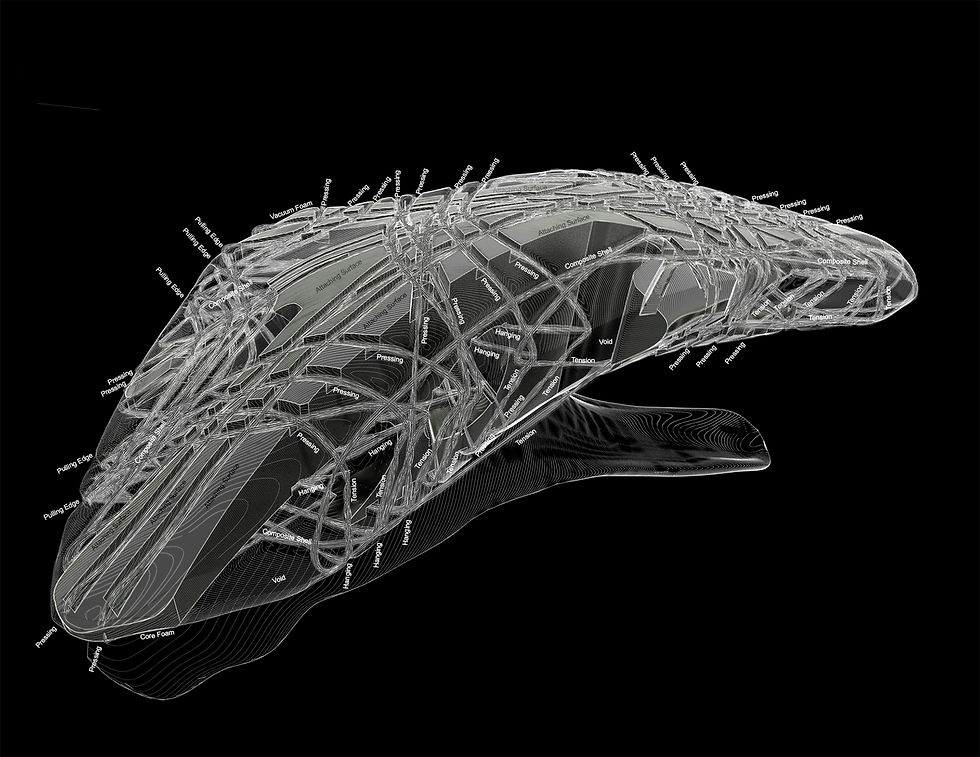
肌體描繪 - 人體拓樸
muscular drawing- human body topology

學術作品 @ 南加州建築學院
細節:畢業專題, zbrush, grasshopper, rhino
期間: 2014 秋 - 2014 夏
設計成員:starry
academic work @ sci-arc
details: design thesis, zbrush, grasshopper, rhino
duration: 2014 autumn-2014 summer
design team: starry
如同醫療領域,建築表現不能單靠文字描述,也使其成為一個複雜的組織。建築的表現需同時能反映與溝通,也得處理多維度與確保其可度量性。以表現法來說,醫學與建築相似處在於有一套嚴謹的形態學。在建構形體,解剖學努力建構一個更準確的領域。人體各部件可證明此觀點,建築已喜好人體不論是作為完美比例(維特魯威人),或是模組人所構成的聯想: 人體已成為度量尺度的一把尺。這個論述著重在於透過塑形,分析,標記的技巧,以期推向建築結構,幾何與體塊的原型。
Like medical field, architectural representation cannot rely solely on text description. This makes it become a complex enterprise. Representation in architecture must be simultaneously projective and communicative. It must also address, at some point, dimensionality and technical measurability. What medicine and architecture have in common, in terms of representation, is in a rigorous approach to morphology. In modeling the body, anatomists strive for a high level of realism and accuracy. Human body parts attests to this. Architecture has preferred the abstraction of the body, either through proportional ideality (vitruvian man) or utility (modular man), eschewing any realist associations: body as metaphor or measuring stick. This thesis looks at the representational possibilities afforded by initiating the architectural process with a fully formed primitive, analysing it through notational techniques, and moving it towards a proto-architecture through the modes of structure, geometry, and mass.